
The Future of L&D Is Not Training. It's Workforce Capability.
For decades, Learning and Development has been largely defined by training. Organizations identified skill gaps, built courses, delivered programs, tracked completions, and measured participation. While the tools and delivery methods evolved, the fundamental mission remained relatively consistent: help people learn new knowledge and skills.
That model served organizations well for a long time.
But the environment around us has changed.
Artificial intelligence is accelerating the pace of work. Roles are evolving faster than job descriptions can be updated. Entire workflows are being redesigned. The half-life of skills continues to shrink, while expectations for adaptability continue to grow. In this environment, simply delivering more training is unlikely to be enough.
The organizations that thrive in the years ahead will not necessarily be the ones that offer the most learning content. They will be the ones that build the strongest workforce capabilities.
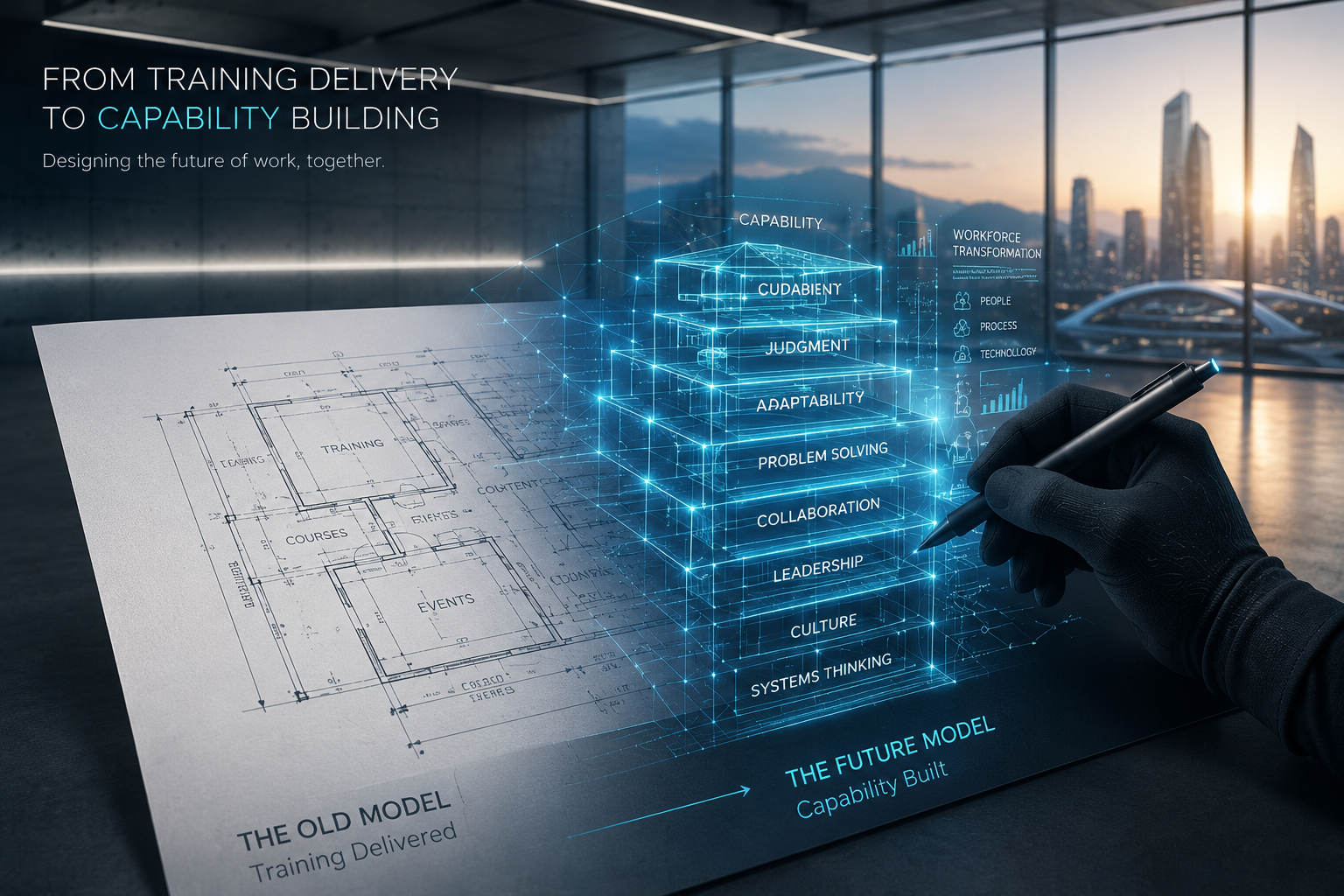
There is an important distinction between skills and capability. Skills describe what someone knows how to do. Capability reflects whether an individual, team, or organization can consistently perform, adapt, solve problems, and create value in changing conditions. Capability combines skills, judgment, experience, systems, processes, leadership, culture, and the ability to learn continuously.
This distinction becomes even more important in the age of AI.
Today, many organizations are investing heavily in AI training. Employees are learning how to write prompts, use copilots, interact with chatbots, and automate tasks. These are valuable skills, but they are only part of the equation. As AI makes information more accessible and content generation easier, the differentiator shifts away from simply producing outputs and toward making good decisions.
The question is no longer, "Can employees use AI?"
The more important question is, "Can employees use AI to make better decisions, solve better problems, and improve outcomes?"
That requires capabilities that extend far beyond technical proficiency. Critical thinking, judgment, systems thinking, adaptability, collaboration, change agility, and leadership become even more valuable when AI is part of the workflow. In many ways, AI increases the importance of these uniquely human capabilities rather than diminishing them.
This creates an opportunity for Learning and Development to evolve.
Rather than focusing primarily on courses, programs, and content libraries, L&D can become the function that helps the organization build capability at scale. This means partnering more closely with leaders, HR, IT, PMOs, and operational teams to understand how work is changing and what capabilities will be needed to succeed in the future.
It means helping organizations answer questions such as:
What capabilities will be most critical in an AI-enabled workplace?
How do we help managers lead through continuous change?
How do we develop stronger decision-making and problem-solving skills?
How do we build adaptability across the workforce?
How do we create systems that support learning in the flow of work?
The future of L&D may have less to do with delivering training and more to do with architecting performance.
This shift also changes how success is measured. Instead of focusing primarily on completions, attendance, and satisfaction scores, organizations will increasingly need to measure workforce readiness, capability growth, adaptability, leadership effectiveness, and business outcomes.
The most effective learning leaders will become workforce strategists. They will help organizations anticipate change, identify capability gaps before they become business problems, and create environments where people can continuously grow alongside technology.
AI is not reducing the importance of Learning and Development. If anything, it is expanding it.
The future belongs to organizations that can continuously learn, adapt, and transform. Building that kind of workforce requires more than training.
It requires capability.
And that may be the most important opportunity L&D has ever had.