
The Work We Were Never Meant to Do
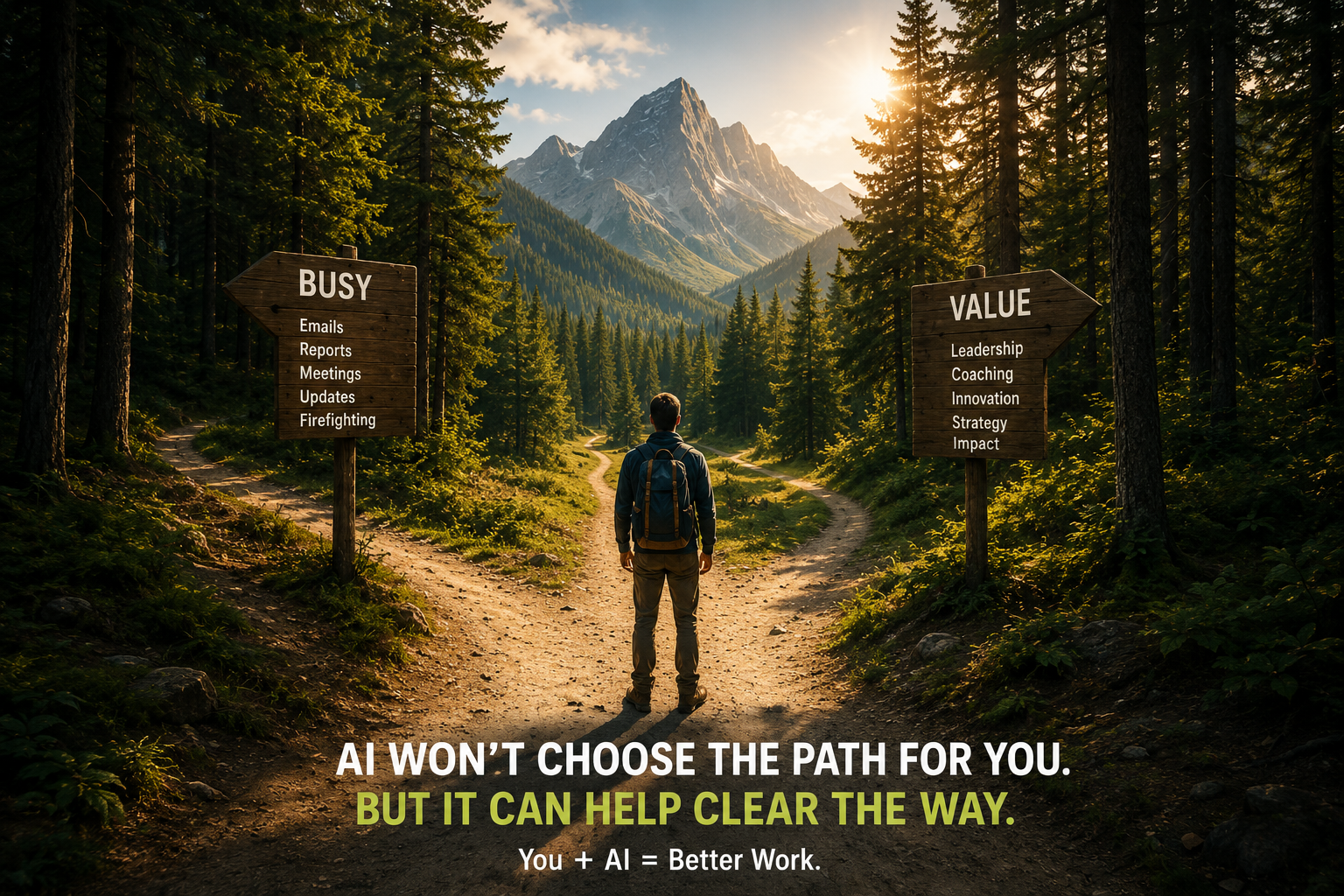
A few months ago, I asked a group of managers a simple question: How much of your week is spent doing work that truly requires your expertise? Not work that requires your attention. Not work that requires your approval. Work that genuinely depends on your experience, judgment, creativity, and perspective. The room was quiet for a moment before one leader laughed and said, "Maybe half." The rest of the group nodded. Nobody argued. In fact, most seemed relieved that someone had finally said it out loud.
That answer has stayed with me because it highlights something many organizations are beginning to confront. Despite all of our investments in technology, productivity, and efficiency, a surprising amount of knowledge work still consists of activities that don't fully utilize human capability. Meetings end and someone has to summarize them. Projects begin and someone has to create agendas, gather information, and coordinate schedules. Leaders spend hours drafting updates, searching for information across multiple systems, formatting presentations, documenting decisions, and translating ideas from one format into another. None of these tasks are inherently difficult, but together they consume an extraordinary amount of attention and energy.
For decades, we accepted this as the cost of doing business. Just as factory workers once accepted repetitive physical labor as an unavoidable part of manufacturing, knowledge workers came to accept administrative and informational labor as an unavoidable part of modern work. We built careers around managing it, organizations around coordinating it, and entire systems around tracking it. Yet the more I observe how people work, the more I wonder whether we've mistaken necessary work for valuable work.
When people talk about artificial intelligence, the conversation often drifts toward extremes. Some predict widespread job displacement, while others dismiss AI as little more than a sophisticated search engine. Both perspectives overlook what may ultimately prove to be the most significant change. The real story may not be that AI replaces knowledge workers. The real story may be that AI helps us reconsider which parts of knowledge work should have required human attention in the first place.
History offers an interesting parallel. The Industrial Revolution did not eliminate the need for people. It changed where people spent their effort. Machines took over repetitive physical tasks, allowing human labor to shift toward activities that required judgment, problem-solving, coordination, and innovation. Looking back, it seems obvious that people should not spend their days performing work that machines could do more efficiently. Yet we may be facing a similar realization today. The bottleneck in many organizations is no longer physical labor. It is cognitive labor, or more specifically, the countless small administrative tasks that absorb attention without creating significant value.
This distinction matters because many organizations are approaching AI primarily as a technology initiative. They focus on selecting tools, establishing governance structures, and identifying use cases. Those conversations are important, but they may not be the most important conversations. The deeper challenge is not technological. It is organizational. It requires leaders and employees to examine how work is structured and ask a deceptively simple question: Which parts of this work genuinely require human judgment, and which parts simply require completion?
That question has profound implications for learning and development. Historically, our role has been to help people build new knowledge and skills. We taught communication, leadership, project management, coaching, and technical expertise. Increasingly, however, we may find ourselves helping organizations build a different capability altogether. The future may depend not only on teaching people how to use AI tools, but on teaching them how to rethink the nature of work itself. Employees will need to learn how to distinguish between contribution and activity, between work that advances outcomes and work that merely consumes time.
The difference is more important than many organizations realize. A leader coaching a struggling employee creates value. A team solving a customer problem creates value. A manager navigating uncertainty and helping people move forward creates value. Yet many of the tasks that dominate our calendars each week contribute little beyond keeping the machinery of work running. We have become so accustomed to these activities that we rarely stop to question them. Instead, we often reward busyness, responsiveness, and visible effort while overlooking whether that effort is being invested in the right places.
Perhaps that is why AI feels both exciting and unsettling. It forces us to confront an uncomfortable possibility. If a machine can complete certain tasks in seconds, then perhaps those tasks were never the highest and best use of human attention. This does not diminish the importance of people. If anything, it elevates it. The less time we spend summarizing, formatting, documenting, and organizing, the more time we can invest in the capabilities that remain uniquely human: judgment, empathy, creativity, relationship-building, coaching, leadership, and strategic thinking.
Key Insights
The greatest opportunity for AI may not be automating jobs—it may be reducing cognitive drudgery.
Workforce transformation is increasingly about redesigning work, not simply digitizing it.
Employees need more than AI skills; they need the ability to identify which work requires human judgment and which work can be delegated to technology.
As routine tasks become automated, uniquely human capabilities such as leadership, coaching, creativity, empathy, and strategic thinking become more valuable.
Organizations that protect employee attention may gain a greater advantage than organizations that simply deploy more technology.
The future of work is not "AI instead of people." It is people spending less time on low-value work and more time on high-value contribution.
The organizations that thrive in the years ahead may not be the ones that adopt the most AI tools or automate the greatest number of processes. They may be the ones that become most intentional about protecting human attention. Information is no longer scarce. Technology is becoming increasingly abundant. Attention, however, remains finite. Every hour spent on low-value cognitive work is an hour that cannot be invested elsewhere.
As a result, the most important question leaders may need to ask is not, "How can we use AI?" but rather, "What work are we asking people to do that people were never meant to spend their time doing?" The answer may reveal opportunities for transformation that have been hiding in plain sight all along.
Because the future of work is not about replacing people with AI. It is about creating the conditions for people to spend more of their time doing what only people can do. In that sense, the most promising AI strategy may not be a technology strategy at all. It may be a human strategy.
You + AI = Better Work.